
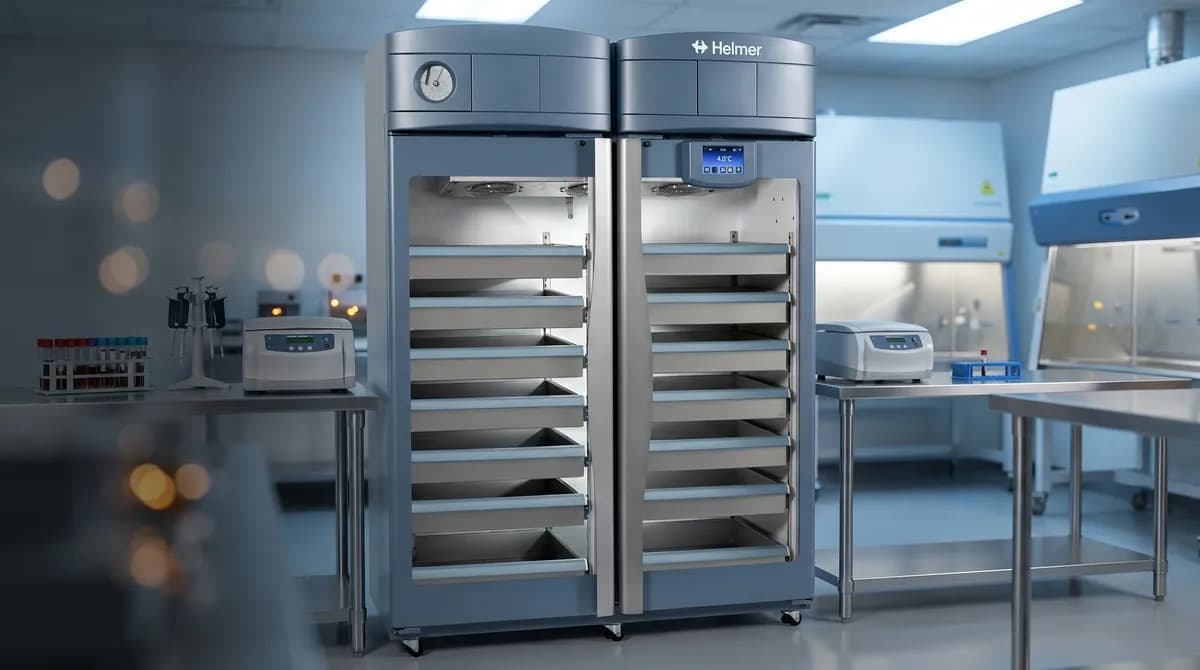
Helmer Scientific
An eight-year digital platform partnership that carried Helmer Scientific from a crowded mid-market into Trane Technologies' life sciences portfolio — and is still running.

Leads spiked the week the site launched. Then engagement. Then sales — enough that demand outran what the existing operation was built to ship. The strategic answer, eventually, was a multi-billion dollar acquirer with the capital to scale. Today Helmer Scientific sits inside Trane Technologies' Life Sciences division — one segment of a Fortune 500 climate-technology conglomerate whose broader portfolio spans HVAC, thermal management, and transport refrigeration across commercial, residential, and industrial markets — on the same shelf hospital procurement teams check when they're also evaluating Thermo Fisher.
The platform we built in 2017-2018 is still running. We're still the agency. Eight years, one Fortune 500 acquisition, and the foundation hasn't needed to be rebuilt. What follows is the healthcare SEO case study we'd give you if you asked what eight years of compounding looks like — built on a foundation most agencies skip.
In brief: Helmer Scientific is an FDA GMP and ISO 13485 compliant manufacturer of medical-grade cold storage equipment, acquired by Trane Technologies in May 2023 (CAP TODAY, 2023). Igility built the digital platform in 2017-2018 and has remained Helmer's agency of record through the acquisition and beyond — an eight-year relationship spanning a Fortune 500 ownership change.
Hospitals Don't Buy Refrigerators. They Buy Laboratory-Grade Cooling Technology.
A hospital doesn't buy a blood bank refrigerator the way a consumer buys a beverage cooler. Procurement committees start with compliance: FDA GMP, ISO 13485, ENERGY STAR, NSF/ANSI 456 for vaccine storage. Then temperature uniformity and tolerance variance. Then capacity, footprint, and power draw. Price is often the last filter applied, not the first.
When we inherited the brand in 2017, the previous agency had pulled it in a direction that read consumer-tech — the aesthetic a DTC company uses to sell to shoppers. For Helmer's actual buyers — hospital procurement managers, laboratory directors, blood center supervisors — that direction cost credibility. A blood bank refrigerator manufacturer that markets like a beverage brand doesn't belong on the shortlist when the purchase order requires signoff from a compliance officer, a facilities director, and a CFO.
The RFP question wasn't "can you make it prettier?" It was "can you make it match how our buyers actually purchase?"
That question is the one most agencies skip. It doesn't demo well in a pitch deck. It requires spending weeks before you open Figma. And it's where every line item in the Results section below was actually decided.
Foundation First — Understanding the Customer, Not Decorating Around One
Personas, empathy maps, customer journey artifacts, and a documented voice-and-tone system are tools. The subject was always Helmer's customers.
We ran the foundation work before any wireframe existed. Behavioral personas for hospital procurement managers, lab directors, and blood-center supervisors — not demographic placeholders. Empathy mapping sessions pulling together what those buyers think, see, do, and feel during a procurement cycle. A customer journey from initial research through RFQ through purchase order. A voice-and-tone system calibrated to clinical-register writing — because generic "industry-leading cold storage solutions" doesn't survive a compliance review the way "FDA GMP and ISO 13485 compliant blood bank refrigerator maintaining 1–6°C with ±0.5°C uniformity" does.
Every artifact translated into a platform decision.

The personas showed that procurement managers filter by compliance certification before price. That finding became the first tier of the faceted search. The empathy maps showed that committees need side-by-side specification comparison to justify a purchase to their CFO. That became the product comparison tool. The customer journey mapped the moment when procurement teams leave the website and call sales — and showed it was happening because questions the website should have answered weren't being answered. That finding restructured the entire content architecture. The voice-and-tone system set the bar that Helmer's product pages still hold, eight years later.
We didn't run these exercises so the deck looked good. We ran them so the filters, the comparisons, and the content standards would match how Helmer's buyers actually think. When you skip this work, you build a catalog. When you don't skip it, you build a procurement workflow.
And here's the part other agencies missed: the clinical voice we documented in 2017 is the same one Helmer uses today, across a Fortune 500 acquisition. Brand directions that get pulled toward "flash" every two years don't compound. The one that held for Helmer did.
Drupal Commerce With Two Jobs — Parts Storefront and Whole-Unit Lead Generation
Most case studies treat a digital platform as a single outcome. Helmer's platform had two distinct commercial jobs, each with its own buyer path and its own conversion surface.
The commerce side sold service parts and accessories. Hospitals that already owned Helmer equipment needed replacement shelves, door gaskets, temperature probes, recording charts, maintenance kits. Those purchases are lower-consideration, higher-frequency, and benefit most from self-service. The commerce stack — Drupal 10 Commerce, Braintree for payments, UPS for real-time shipping calculation across equipment that ranges from countertop units to full-size uprights, AvaTax for jurisdiction compliance — existed to close that transaction without a phone call. Behind the storefront, a custom integration layer we built in Drupal connected the commerce front end to Helmer's back-office systems: orders placed in Drupal Commerce flowed into Microsoft Dynamics CRM for fulfillment and customer-record posting, and price lists pushed from Helmer's legacy ERP into Drupal Commerce on a synchronized schedule so storefront pricing always mirrored the system of record. The integration ran on a reliable queue process — orders and price-list updates were durably persisted, retried on transient failures, and replayed after maintenance windows, so a back-office outage never cost a transaction or left commerce pricing out of sync.
The informational side generated leads for whole-unit sales. A blood bank refrigerator is not a self-service purchase. It's a capital equipment decision that moves through procurement committees, compliance officers, and multi-stakeholder approval chains. The job of the informational platform wasn't to close the sale; it was to carry procurement teams far enough through their evaluation that they arrived in the sales team's inbox with specifications already in hand. HubSpot — the system Helmer's marketing and sales teams used for lead management — captured every spec sheet download, product comparison, and quote request, not as vanity metrics but as context. When the sales rep picked up the conversation, they already knew which models the prospect had evaluated, which certifications they'd filtered for, and which competitors they'd compared against.
The two sides weren't bifurcated — they were integrated. Most life sciences vendors run a marketing site, a separate e-commerce portal, a third-party knowledge base, and a fourth quote-request form, each with its own login, design system, and customer-service workflow. Jumping between four disconnected surfaces breaks trust with a procurement team already cautious about a six-figure capital purchase. Helmer's platform unified them. A hospital buyer could research a whole-unit refrigerator, download a spec sheet, place two i.Series models side-by-side in the comparison tool, order replacement gaskets for equipment they already owned, pull up a maintenance SOP, and submit a whole-unit quote request — all inside one continuous experience with one brand, one login, one checkout. Support content sat next to commerce. Commerce sat next to lead gen. The customer never had to switch brands to finish what they came for — and the procurement committee never had to explain to the CFO why the vendor evaluation required four different vendor-facing experiences.
Shared infrastructure made the integration possible. Apache Solr powered faceted search across the full catalog — application type, temperature range, capacity, ENERGY STAR certification, product series — tuned to how hospital buyers filter rather than how product managers categorize. The side-by-side comparison tool aligned specifications row-by-row: internal volume, temperature uniformity, energy consumption, door configuration, regulatory certifications. Multi-language support in four languages covered Helmer's distribution network across 125+ countries.
None of this is architecturally novel. Drupal Commerce, Solr, Braintree, HubSpot, Microsoft Dynamics, a queue-backed ERP integration — known tools. The difference is knowing which filters to build, which specifications belong in the comparison, which lead signals belong in HubSpot, and which order and pricing data have to synchronize with Dynamics and the ERP. Those decisions came from the foundation, not the technology selection.
Launch: Three Metrics, One Lead-Volume Lift, and a Clutch Review That Still Holds
Within three months of launch, the platform delivered on both of its jobs (metrics validated via the Clutch review that still sits on our profile):
- +20% organic traffic — healthcare SEO tuned to how procurement managers actually search ("blood bank refrigerator FDA compliant," "ENERGY STAR pharmacy vaccine refrigerator") with structured product data and long-tail keyword targeting. Top-of-funnel growth fed both commerce and lead generation.
- +35% sales — on the commerce side, the service parts and accessories e-commerce flow produced a step-function lift. Faceted search, CRM-connected inquiries, and self-service comparison replaced phone calls for aftermarket purchases.
- -28% bounce rate — hospital buyers found what they needed. The filters worked the way they think. They stopped leaving to call a sales rep for answers the site should have delivered.
And on the informational side, whole-unit lead volume for the sales team climbed — bringing the sales reps more qualified, pre-researched inbound conversations. Leads arrived with context: which refrigerator lines the prospect had compared, which certifications they'd filtered for, which competitors appeared in their evaluation. The sales team stopped opening every call with "what are you looking for?" and started with "let's talk about the two models you already compared."
"Igility was the right choice for the advanced magnitude of scope of this project." — Josh Wilhite, Web Manager, Helmer Scientific (Clutch.co Review)
Helmer team members still refer to the project as "massively successful" — a description that has outlasted the platform launch, a CMO change, and a Fortune 500 acquisition.
Sales Momentum That Drove Manufacturing Expansion and Acquisition
A platform that sustains compounding sales momentum produces strategic options that a static catalog never does.
The commercial momentum the platform produced — combined aftermarket revenue growth, lead volume expansion, and the corresponding growth in whole-unit sales that the expanded pipeline carried — compounded year over year into a demand profile that justified continued manufacturing expansion and, eventually, a strategic transaction. Sales growth sustained over five years in the medical device mid-market is rare enough that it tends to reshape a company's capital options — both what the business can fund internally and what it attracts externally.
Helmer expanded production as sales climbed. Both paths — internal capacity investment and strategic partnership — eventually came into play.
From the Crowded Middle to the Thermo Fisher Tier
From where we sat — inside Helmer's procurement conversations, reading the RFPs that came back, watching the competitive set shift — Helmer's brand elevated over the five years the platform was live.
Hospital procurement teams evaluating medical-grade cold storage don't invite twenty vendors to respond to an RFQ. They invite a short list. Thermo Fisher Scientific is almost always on that list — a Fortune 500 life sciences incumbent whose cold storage portfolio runs across research, clinical, and pharmaceutical applications. Getting onto a Thermo Fisher-adjacent shortlist isn't a ranking achievement — it's a positioning one. The vendors that make those lists carry credibility signals that the ones stuck in the crowded middle don't: clinical voice that matches the buyer's regulatory context, platform UX that reads like a medical-device company instead of a consumer brand, compliance posture that signals enterprise-grade infrastructure, and a content standard that holds over years.
Helmer moved into that consideration tier. We won't claim our platform was the only reason; we will claim it was one of the reasons the brand stopped reading like a crowded mid-market player and started reading like a company that belonged next to Thermo Fisher on a procurement shortlist.
This is the kind of outcome that doesn't show up in a dashboard. It shows up in the list of vendors an RFP goes out to.
Then Trane Acquired the Company
On May 15, 2023, Trane Technologies acquired Helmer Scientific (CAP TODAY, 2023). The acquisition added Helmer to Trane's life sciences portfolio, which already included precision temperature-controlled storage across clinical, acute care, and life sciences markets.
The platform went into corporate due diligence. Compliance architecture that had been a design input from the first sprint — PCI, SOC 2, SOX, penetration testing, hosting and security SOPs — didn't need a cleanup project to meet Trane's corporate standards. The transition into a multi-billion-dollar acquirer's compliance regime was a non-event. Not because we got lucky; because enterprise-grade compliance was built into the platform years before anyone knew there would be a transaction.
We don't claim our website got Helmer bought. We observe that the platform carried a demand profile and a compliance posture that made Helmer a credible premium acquisition target — and that the transaction followed. The story tells itself from there.
Eight Years In, Still the Agency of Record
Most medical device marketing agency relationships don't survive one CMO change. This one survived a Fortune 500 acquisition.
Igility has been Helmer's digital partner since 2017. Through launch, through platform iterations, through the 2024 PCI assessment, through penetration testing cycles, through SEO optimization and content creation across the product catalog, through the 2025 Cloudflare transition, through the Platform.sh hosting evaluation, through multiple SOPs for website testing, SSL renewal, and customer-service workflow. The Master Services Agreement now runs through Trane Technologies; the operational work runs through Igility the same way it has since 2017.
This isn't lock-in. There's no proprietary platform holding Helmer hostage — it's Drupal, it's HubSpot, it's Microsoft Dynamics, it's Cloudflare, it's standard open-source and commercial infrastructure they could move at any time. The foundation compounds because the customer understanding we built in 2017 is still the best description of how Helmer's buyers evaluate cold storage in 2026, and because the compliance architecture we engineered for a privately-held medical device company happened to be enterprise-ready when Trane showed up. What pays off repeatedly is rare enough that clients keep it around.
That compounding pattern repeats across Igility's portfolio. The Mobile Mini platform — Igility's 2018 Acquia Engage Award winner for Best Return on Investment — has now run for nine years through a public-company merger with WillScot. Helmer's 2020 Acquia Engage Best ROI win was the second in a three-in-four-year streak (InkJet completed the trifecta in 2021). Foundations-first platforms behave the same way across verticals.
What Comes Next — Healthcare SEO Becomes Answer Engine Optimization
Healthcare procurement is moving into AI-assisted research. Seventy-three percent of B2B buyers now use AI tools during purchase research (Averi, 2026). Sixty-nine percent of B2B software buyers chose a different vendor than they originally planned, based on AI chatbot guidance (G2 Research, 2026). In healthcare specifically, 61% of large hospital networks planned AI-assisted procurement tools by the end of 2026, up from 18% in 2023 (Gartner, 2025).
The platforms AI systems can find and cite are the ones with structured product data, consistent terminology, entity-defined content, and schema markup. Helmer's platform has those foundations. The product pages carry the specification detail AI systems extract. The content standard matches the clinical register AI models weight as authoritative in regulated domains. The compliance posture signals the trust AI systems apply to healthcare content. The next phase of the work is Answer Engine Optimization (AEO) — the discipline of structuring content so AI systems like ChatGPT, Perplexity, Gemini, and Google AI Overviews cite your brand in their answers. Healthcare SEO taught the industry how to rank on Google. AEO is how healthcare brands now get named inside AI answers. For a walkthrough of the methodology, see the B2B AEO guide; for the diagnostic that catches the invisibility first, see why brands miss ChatGPT citations.
The foundation we built in 2017 is still the foundation the next phase of work sits on top of. If you want to know where your own brand sits across Google and eight AI platforms — the same diagnostic we run on every new engagement — start with the free AI visibility audit.
Frequently Asked Questions
What does "clinical brand voice" mean for a medical device manufacturer?
Clinical voice is the register a regulated-industry buyer expects: precise, quantified, specification-forward, and stripped of marketing abstraction. For Helmer, it meant replacing phrases like "industry-leading cold storage" with phrases like "FDA GMP and ISO 13485 compliant blood bank refrigerator maintaining 1–6°C with ±0.5°C uniformity." The second phrasing survives a procurement committee; the first one doesn't. Clinical voice is measurable: every product page matches the regulatory rigor Helmer applies to its equipment.
How does starting from customer understanding, not personas alone, change what a platform actually does?
Personas are an artifact of customer understanding, not the understanding itself. A platform built around personas alone tends to treat the personas as the deliverable — fictional profiles that sit in a presentation deck. A platform built around the customer treats personas as one of several tools (empathy mapping, customer journey, voice and tone, benchmarking) that together describe how the buyer actually evaluates a purchase. The test is whether the platform's features — faceted search filters, comparison tools, content standards, CRM data fields — map one-to-one to documented buyer behaviors. For Helmer, every capability traces to a specific finding about how hospital procurement committees make decisions.
What does an 8-year agency relationship actually look like past year 2?
The scope shifts from building to compounding. The first two years are the platform build plus post-launch iteration. Years three through five are feature extension, content program expansion, and performance optimization. Years six through eight are compliance maintenance, infrastructure evolution (hosting transitions, CDN work, security reviews), SEO audits, and keeping the platform aligned as the business changes. For Helmer, year seven included the company's acquisition by Trane Technologies; the agency relationship continued through the transition because the platform work still needed to be done and the foundation made it efficient to keep doing. The retention profile isn't about lock-in — it's about the cost of switching when nothing is broken.
Does a platform built in 2018 still position Helmer for AI-assisted procurement search?
Structured product data, consistent entity definitions, schema markup, and clinical-register content are exactly what AI systems weight for citations. Helmer's platform was built with those foundations because that's what hospital procurement buyers needed in 2018 — and it happens to be what AI systems need to find and cite a brand in 2026. The platform doesn't need to be rebuilt to support AI visibility; it needs an Answer Engine Optimization layer that surfaces the existing content the way AI retrieval systems discover authoritative sources. That's the current phase of work.
What does a medical device ecommerce platform need that a generic ecommerce platform doesn't?
Compliance-first faceted search filters (FDA GMP, ISO 13485, ENERGY STAR, NSF/ANSI 456 for vaccine storage), side-by-side specification comparison tuned to regulated fields like temperature uniformity and tolerance variance, clinical-register product copy that survives a compliance review, structured product data that procurement committees can extract into an RFP, and a back-office integration layer that keeps storefront pricing synchronized with the ERP system of record. A generic ecommerce platform sells to consumers who filter by color and price. A medical device ecommerce platform sells into hospital procurement committees who filter by certification and uniformity specification — and it has to do so without forcing buyers to call sales for what should be self-service.
Why do hospital procurement committees require side-by-side specification comparison before they'll shortlist a cold storage vendor?
A blood bank refrigerator is not bought by one person — it's bought by a committee. The CFO needs cost justification. The facilities director needs capacity and power-draw comparisons. The compliance officer needs certification parity across evaluated units. The laboratory director needs temperature uniformity and tolerance variance comparisons. Side-by-side comparison reduces that multi-role evaluation from a multi-week spreadsheet exercise to a single-page decision — and vendors whose websites can't produce that comparison in one view tend to get dropped before they make the shortlist. Removing the friction is how a vendor moves from longlist to shortlist to purchase order.
References
Acquisition
- CAP TODAY (2023). "Trane Technologies Acquires Helmer Scientific." CAP TODAY. Acquisition announcement and context.
Client Attestation
- Clutch (2019). Review of Igility by Helmer Scientific's Web Manager, Oct 2018 – Sep 2019 engagement. 5.0 / 5.0 / 5.0 / 5.0 scores across Quality, Schedule, Cost, Willing to Refer.
B2B Buyer AI Adoption
- Averi (2026). "73% of B2B Buyers Use AI Tools in Purchase Research, Multi-Source Analysis Finds." Yahoo Finance / PR Newswire. Analysis of 680 million citations, March 2026.
- G2 Research (2026). "Half of B2B Software Buyers Now Start Their Research With AI Chatbots." PR Newswire. 51% start with AI chatbot, up from 29% eleven months prior. 69% chose a different vendor based on AI guidance.
Healthcare AI Procurement
- Gartner (2025). "How Cloud and AI Are Transforming Healthcare Procurement." GHX Healthcare Hub. 61% of large hospital networks planned to deploy AI-assisted procurement tools by end of 2026, up from 18% in 2023.
Technologies Used
Ready to be the next success story?
Let's talk about what we can build together. Start with a free audit or jump straight into a conversation.