
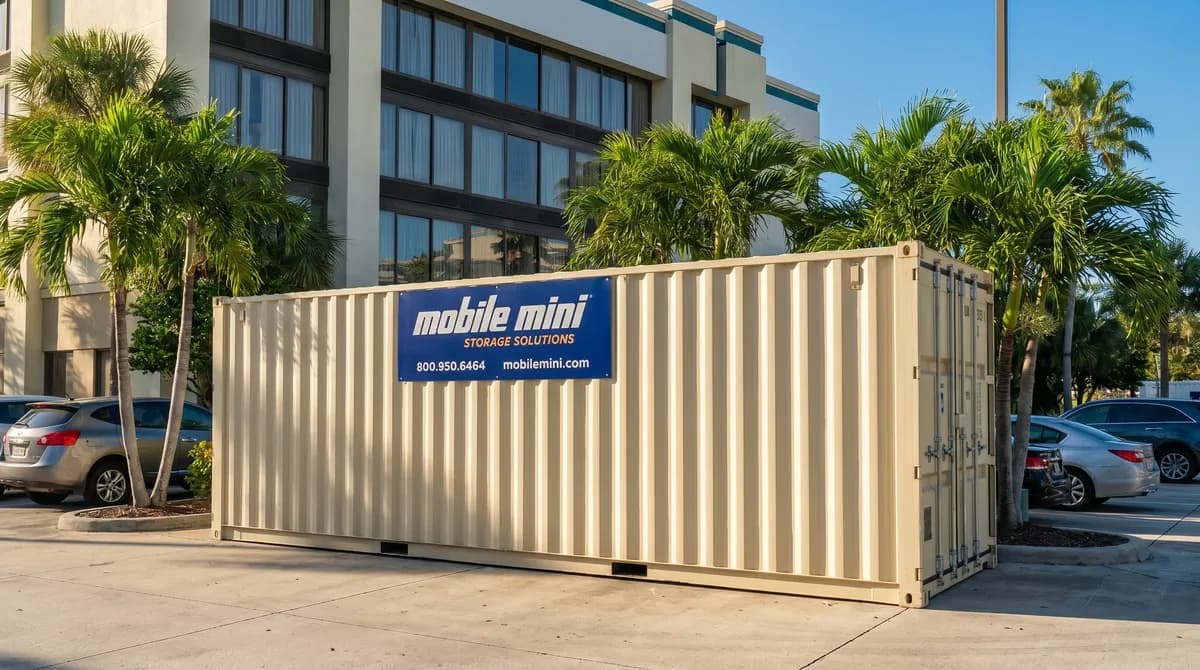
Mobile Mini (now part of WillScot Mobile Mini Holdings, NASDAQ: WSC)
How a 2017 Mobile Mini brand consolidation compounded into the 2018 Acquia Engage Award for Best Return on Investment, the 2020 WillScot public-company merger, and an active ongoing engagement.
Mobile Mini hired Igility in 2017 with three acquired brands and a website nobody on the marketing team could edit.
The mandate was a brand consolidation, not a redesign. Three businesses needed to present as one experience to a national B2B buyer. 150+ locations across the United States, Canada, and the United Kingdom each needed local relevance, served from one central platform. The work in front of us was the architecture that could carry the brand for the long term — not just to launch day.
Nine years later — through four marketing teams, three CEOs, the 2018 Acquia Engage Award for Best Return on Investment, and the July 2020 public-company merger that created WillScot Mobile Mini Holdings — Igility has always been there to help tell the Mobile Mini story.
What follows is what a B2B lead-generation platform looks like when it's built to compound across every transition a client's business throws at it — a brand consolidation, an Acquia ROI award, a React-and-chat mid-life rebuild, a public-company merger, and the years of feature work that come after.
In brief: Igility built Mobile Mini's national lead-generation platform in 2017; it broke even on the build investment within 90 days on a 23% lift in leads year over year and a 30% lift in conversions, won the 2018 Acquia Engage Award for Best Return on Investment, and carried the brand through its July 2020 public-company merger with WillScot without a rebuild. Four marketing teams, three CEOs, and nine years later, the platform still runs.
Brand Consolidation Over a Rebuild Nobody Could Edit
Mobile Mini's starting position in 2017 was the one every marketer dreads: an 18-month-old website the marketing team couldn't edit. A rigid CMS that required a developer for every content change. A six-week development cycle for what should have been a ten-minute update. And on top of that — three acquired business units operating under fractured brand identities, with 150+ locations across the United States, Canada, and the United Kingdom. The company was a rapidly growing mid-tier enterprise ($300M revenue) whose digital infrastructure had not kept pace with its corporate trajectory.
The work in front of us wasn't a redesign. It was a brand consolidation: how do you present three acquired businesses to a national B2B buyer as one experience, while giving the marketing team the agility to run local campaigns across hundreds of markets?
That problem has two layers. The surface layer is visual consistency — one logo system, one typography hierarchy, one color language across three formerly independent brands. The harder layer is navigation: how does a construction buyer in Phoenix find the right portable storage container, a government logistics coordinator in Ottawa find the right ground-level office, and an oil-and-gas operations manager in Aberdeen find the right tank-and-pump unit, all inside one coherent site? Three buyer personas, three geographies, three product lines. One experience.
The brand consolidation was the mandate. The platform that could carry it for the next decade was what we actually had to build.
"Igility Solutions took the time to understand Mobile Mini at a level that even today we often forget that the Igility team is not on staff. That commitment turned a looming website build into an engaging, thoughtful and thoroughly professional journey — one that achieved a customer experience and an ROI to be proud of." — Ruzica Radulovic, then Executive Director of Marketing & Communications, Mobile Mini
Foundation First — How B2B Storage Actually Gets Bought
Before any wireframe, before any typography specimen, we ran foundation work. Behavioral personas for construction operations managers, government procurement officers, oil-and-gas logistics coordinators, and the hospitality-industry buyers Mobile Mini served. Empathy mapping to document what each of those buyers thought, saw, did, and felt during a B2B storage-rental cycle. Customer-journey mapping from first awareness through quote through delivery. Secondary research from Accenture's omnichannel B2B customer engagement report and UPS's 2017 Industrial Buying Dynamics study — the two most rigorous pieces of third-party research we could find on how B2B industrial buyers actually research, evaluate, and commit to vendor relationships.
The findings became platform decisions, not presentation slides.
The personas showed that B2B storage buyers filter by location before anything else — they want to know what's available locally, what local fleet the vendor can deliver on, and what the local service relationship looks like. That became the first tier of navigation and the foundation of the geo-personalization we built at launch. The empathy mapping showed that buyers needed quick clarity on what a given product category actually was — portable storage container vs. ground-level office vs. tank-and-pump unit — because most buyers were not experts in industrial storage. That became the information architecture. Secondary research from the UPS Industrial Buying Dynamics study showed that a majority of B2B industrial buyers consult a vendor's website before a quote request, and most abandon the site if the specification detail they need is missing. That became the content standard on every product page.
We organized the three acquired business units into three clearly-differentiated product categories: Portable Storage, Tank & Pump, and Ground-Level Offices. The result of that consolidation, measured against the prior site's navigation, was an increase in time-on-site, a reduction in bounce rate, and ultimately an increase in conversion — the IA decision compounded every month for years.
We didn't run the discovery because it looked rigorous. We ran it because we needed the platform to match how Mobile Mini's buyers actually evaluated a rental, and that answer wasn't going to come from a focus group or a brand deck.
Drupal + Salesforce — the Platform That Became the Beating Heart of Sales Ops
The technical foundation was Drupal 8 on Acquia's Enterprise Cloud platform with PCI compliance built in — enterprise architecture at launch, not added later under audit pressure. Drupal is an open-source content management system used by enterprises that need deep customization and long-term platform control. Acquia Enterprise Cloud is Acquia's managed Drupal hosting environment with PCI Level 1 compliance built into the infrastructure stack. Apache Solr — the open-source enterprise search engine — powered faceted search across the product catalog. Acquia Cloud's IP-localization feature enabled the geo-personalization layer: visitors to the site saw content and local-market stories matched to their approximate location, across 150+ markets in three countries.
The piece of the architecture that did the most work — and that kept working through every subsequent business transition — was the custom Salesforce integration. Every form submission on the site hit a Drupal webform first, which persisted the lead durably, then posted it to Salesforce for sales routing. The durable-first pattern was deliberate: if a downstream Salesforce issue ever interrupted the lead flow, we'd still have the leads in Drupal as a backstop, ready to replay or reconcile. That architectural choice turned the Salesforce integration into the beating heart of Mobile Mini's sales operation — every inbound lead, every quote request, every location-specific inquiry, routed and attributed through the pattern Igility built.
The architecture made one other thing possible: the website became the company's source of truth for product information — externally for customers browsing, internally for Mobile Mini employees. Product specs, unit dimensions, regional availability, accessory compatibility — internal teams consulted the site the same way customers did, because it was the only place the data lived in a form anyone could find. Most B2B marketing sites never earn that internal trust. Mobile Mini's did, which is part of why it survived the transitions that came next.
For /services/campaign-orchestration prospects evaluating whether Igility's lead-generation platform discipline extends beyond healthcare and life sciences: this is the parallel vertical. Same architectural discipline, different industry. The decisions that held for Mobile Mini's national lead-generation platform were the same class of decisions that would hold for Helmer Scientific's medical-device platform three years later and for InkJet's manufacturing platform three years after that.

Launch: Break-Even in 90 Days, Five Numbers, and the Acquia Best ROI Award
The platform went live in September 2017. Within the first 90 days after launch, the project broke even on the build investment. The five metrics that drove the break-even (sourced from Igility's internal 2019 case-study copy deck, the authoritative record of the launch-era results):
- 500% increase in customer use of the new portal
- 40% increase in time-on-site
- 40% reduction in bounce rate
- 23% increase in leads year over year
- 30% increase in site conversions
Break-even on a build investment in 90 days is the kind of number an Acquia Engage Awards panel responds to. It's also the kind of number a marketing leader presenting to a CFO needs.
Five months after launch, in February 2018, Mobile Mini signed Igility directly — formalizing into a direct client engagement what had begun as a launch partnership. The ongoing maintenance, feature evolution, and platform stewardship all ran through that direct MSA.
Ruzica's June 2018 email — the one quoted at the top of this case study — called the result "an ROI to be proud of." Four months later, on October 24, 2018, a panel of Drupal-community experts at the Acquia Engage Awards independently reached the same conclusion. Mobile Mini and Igility Solutions were named the winners of the "Best Return on Investment" category at the 2018 Acquia Engage Awards.
This was the first of Igility's three Acquia Engage wins in four years. The second came in 2020 for Helmer Scientific — in the same "Best Return on Investment" category, a back-to-back discipline. The third came in 2021 for InkJet, Inc. in the "Leader of the Pack: Manufacturing" category. Three awards in four years — the streak started here.
Mid-Life Reinvention: React, a Dynamic Configurator, and a Chat System That Closed Sales
Two years into the platform's life, in July 2019, we shipped the mid-life reinvention — a full rebuild of Mobile Mini's product pages on a React-based front end, integrated into the existing Drupal content model. The React pages introduced a dynamic product configurator that let buyers spec out a unit — size, door configuration, accessories, regional availability — in real time, without leaving the page. Paired with the configurator: an integrated chat system that handled product questions and sales conversations on the same screen. Buyers asked a quote question, got a human or agent response, and finished the interaction without switching contexts.
The operational consequence was meaningful: product requests and sales conversations began closing entirely inside the chat system. What had been a multi-step flow — research the product, fill a quote form, wait for a sales rep to reach out, exchange several emails — collapsed into a single live interaction on the page where the buyer was already evaluating the unit.
This wasn't a platform replacement. It was an evolution of the surface where buyers and the sales team were actually transacting — a React front-end for product pages, sitting on top of the same Drupal content model, powered by the same Salesforce integration for lead capture. The chat layer was the only commerce surface on the platform; the rest of the architecture remained a content + lead-generation system. For prospects evaluating AI-accelerated platform development: this is the shape of the capability Igility brings — adding a modern interaction layer to an existing platform without requiring a full rebuild. The pattern's been exported to client work since.
WillScot — Platform Carries Through a Public-Company Merger
In July 2020, WillScot Corporation and Mobile Mini Inc. merged, forming WillScot Mobile Mini Holdings (NASDAQ: WSC) — a public-company transaction that combined modular office space leasing with the portable-storage portfolio under one parent brand. The platform we'd built faced its first real test: would the architecture absorb a corporate transition? It did.
No rebuild. No platform migration. The same Drupal architecture, the same Salesforce integration pattern, the same Acquia Enterprise Cloud hosting. What changed was the brand layer and the lead-routing model — post-merger, Mobile Mini leads needed to reach WillScot's expanded sales footprint, which meant extending the Salesforce integration to a lead-sharing pipeline across both parent-brand teams. We shipped the lead-sharing deployment in February 2021, extending the durable-first integration pattern to route leads appropriately for the combined enterprise.
The platform absorbed the merger the way it had absorbed the original 2017 brand consolidation — because the architecture had been built to absorb business transitions, not just to display a brand as it existed on launch day. Platforms that get rebuilt every time the business changes are platforms that weren't built to compound. This one was.
Continuous Evolution Through the WillScot Era
From 2020 through 2024, the platform kept evolving. A homepage redesign in 2021. Enterprise penetration testing in the second quarter of that year. Integration with Accessibe — an AI-driven web accessibility compliance tool — to bring the site into ADA conformance. Ongoing content operations, product-page iteration, compliance maintenance. Years of uninterrupted service through a rebrand, a public-company merger, and multiple rounds of feature evolution. The Drupal 8 codebase was upgraded through Drupal 9 to Drupal 10. The Acquia hosting environment evolved. Nothing about the platform needed to be torn down.
That long run is the proof point most B2B platform engagements never get a chance to make. Most marketing platforms get rebuilt every two or three years, on a different stack, by a different agency, because the foundation underneath them wasn't built to absorb change. Mobile Mini's wasn't.
What Comes Next for B2B Lead-Generation Platforms
B2B lead generation is going through the same shift that reshaped B2B SEO a decade ago. Seventy-three percent of B2B buyers now use AI tools during purchase research, and 51% of B2B software buyers start that research inside an AI chatbot instead of a search engine. More of that research happens inside AI answer engines — ChatGPT, Perplexity, Gemini, Google AI Overviews — where the deciding factor is whether a brand shows up as a recommendation, not whether it ranks on Google. The platforms that will compound through this transition are the ones with structured content, consistent entity definitions, and product information AI retrieval systems can actually cite. That's the discipline we now call Answer Engine Optimization (AEO), and it's the layer Igility now builds on top of the platforms we've built for Mobile Mini, Helmer Scientific, InkJet, and others.
The Mobile Mini platform's foundation — rigorous information architecture, structured product data, compliance architecture, operational specificity, geo-aware content — is exactly what the AEO layer sits on. For a walkthrough of the methodology, see the B2B AEO guide. For the diagnostic that catches the invisibility first, see why brands miss ChatGPT citations. And if you want to know where your own platform sits across Google and eight AI engines — the same diagnostic we run on every new engagement — request a free AI visibility audit.
Frequently Asked Questions
What did Mobile Mini and Igility win at the 2018 Acquia Engage Awards?
Mobile Mini and Igility Solutions won the "Best Return on Investment" category at the 2018 Acquia Engage Awards, announced by Acquia on October 24, 2018. The award recognized the measurable business results produced by the Drupal-based platform Igility built for Mobile Mini's brand consolidation and national lead-generation program — including a 500% increase in customer use of the new portal, a 23% year-over-year lift in leads, and a 30% increase in conversions in the first 90 days after launch. The 2018 Mobile Mini win was the first of Igility's three Acquia Engage Awards in four years, followed by Helmer Scientific in 2020 (Best ROI, back-to-back category win) and InkJet, Inc. in 2021 (Leader of the Pack: Manufacturing).
Is Mobile Mini the same company as WillScot?
Mobile Mini Inc. and WillScot Corporation merged in July 2020 to form WillScot Mobile Mini Holdings (NASDAQ: WSC) — a publicly-traded combined enterprise that offers both modular office space and portable storage solutions. The Mobile Mini brand continues to operate as a business unit of the combined company, serving B2B portable-storage customers across North America and the UK. Igility's engagement began with Mobile Mini in 2017 under Mobile Mini's independent ownership and continued through and beyond the merger under the combined WillScot Mobile Mini parent.
What does a nine-year B2B agency relationship actually look like past year two?
The scope shifts from building to compounding. Years one and two are platform build plus post-launch iteration and optimization. Years three through five tend to be feature extension, content-program expansion, and ongoing performance optimization. Years six through nine — which is where the Mobile Mini engagement sits — are infrastructure evolution, compliance maintenance, SEO audits, and feature work that keeps the platform aligned as the business continues to change. For Mobile Mini, year seven was the WillScot merger; the years that followed continued the same compounding pattern. The engagement is project work today rather than agency of record, but Igility is still the team called when the work needs the original platform architects.
What's the difference between the Mobile Mini platform and a HubSpot or Marketo deployment?
HubSpot and Marketo are SaaS marketing automation platforms — standard data models, standard workflow templates, standard pricing tiers per contact / per send. B2B lead generation at the Mobile Mini scale — multi-brand consolidation across three business units, 150+ geographies, deep custom Salesforce integration with durable-first lead capture, geo-personalized content matching visitors to their local market, and a platform that needs to serve as the source of truth for product information internally as well as externally — needed an architecture with substantially more room to evolve. Drupal + custom Salesforce integration + Acquia Enterprise Cloud is the class of stack that carries that complexity; SaaS marketing automation tends to reach its limits when a platform needs to be the customer-facing site, the lead-capture system, and the company's product-information source of truth all at once. For prospects evaluating that crossover, see the campaign orchestration service overview and the martech stack service overview.
How do you build a B2B marketing platform that survives a public-company merger?
Three architectural decisions load most of the work. First, build on open-source foundations that will outlast any single vendor relationship — Drupal, open-source CMS, standard integration patterns — so the platform isn't locked into a vendor whose pricing or roadmap might shift after the merger closes. Second, design the integration layer (in Mobile Mini's case, the custom Salesforce integration) to persist lead data durably in the platform first, then forward to downstream systems — so when the downstream system changes during the merger integration, leads aren't lost. Third, separate the brand layer from the content and architecture layers so a rebrand can be shipped without a rebuild. When WillScot and Mobile Mini merged in 2020, the Mobile Mini platform absorbed the transition cleanly because those three decisions had been made in 2017 — not because the merger was predicted, but because B2B marketing platforms built to compound have to absorb the transitions the business will eventually throw at them.
References
Award Citation
- Acquia Inc. (2018, October 24). "Winners Unveiled in 2018 Acquia Engage Awards." Acquia Newsroom. Mobile Mini + Igility Solutions winner, "Best Return on Investment" category.
- Business Wire (2018, October 24). "Winners Unveiled in 2018 Acquia Engage Awards." Press release backup.
Client Attestation
- Ruzica Radulovic (2018, June 25). Email to Brad Gronek, subject "Endorsement." Then-Executive Director of Marketing & Communications, Mobile Mini. Permission to use granted in the email; retained in Igility's testimonials record.
Trifecta Context
- Igility Solutions (2020). 2020 Acquia Engage Award, "Best Return on Investment" (Helmer Scientific) — the second Best-ROI win in three years. See Helmer Scientific case study for the full narrative.
- Igility Solutions (2021). 2021 Acquia Engage Award, "Leader of the Pack: Manufacturing" (InkJet, Inc.) — the third Acquia Engage win in four years. Internal archive:
ACQUIA-ENGAGE-AWARDS.md.
Corporate Context
- WillScot Mobile Mini Holdings Corp. — parent company, formed July 2020 via the WillScot Corporation / Mobile Mini Inc. merger. NASDAQ: WSC.
Architecture References
- Acquia Cloud Platform architecture documentation. Enterprise Cloud + PCI compliance — the hosting foundation for the platform.
Launch Metrics
- Igility Solutions (2019). Internal 2019 case-study copy deck, authoritative source for the 90-day launch metrics (500% portal use / 40% time-on-site / 40% bounce reduction / 23% leads YoY / 30% conversion lift).
Secondary Research Consulted During 2017 Foundation Work
- Accenture (2017). "Mastering Omni-Channel B2B Customer Engagement." Internal archive.
- UPS (2017). "UPS Industrial Buying Dynamics Study 2017." Informed the 2017 IA and content-standard decisions.
B2B Buyer AI Adoption (current-era context)
- Averi (2026). "73% of B2B Buyers Use AI Tools in Purchase Research, Multi-Source Analysis Finds." Yahoo Finance / PR Newswire. Analysis of 680 million citations, March 2026.
- G2 Research (2026). "Half of B2B Software Buyers Now Start Their Research With AI Chatbots." PR Newswire. 51% start with AI chatbot, up from 29% eleven months prior.
Technologies Used
Ready to be the next success story?
Let's talk about what we can build together. Start with a free audit or jump straight into a conversation.